North Cambridge Historic Markers (2003-04 series, restored in 2026)
Jerry's Pit
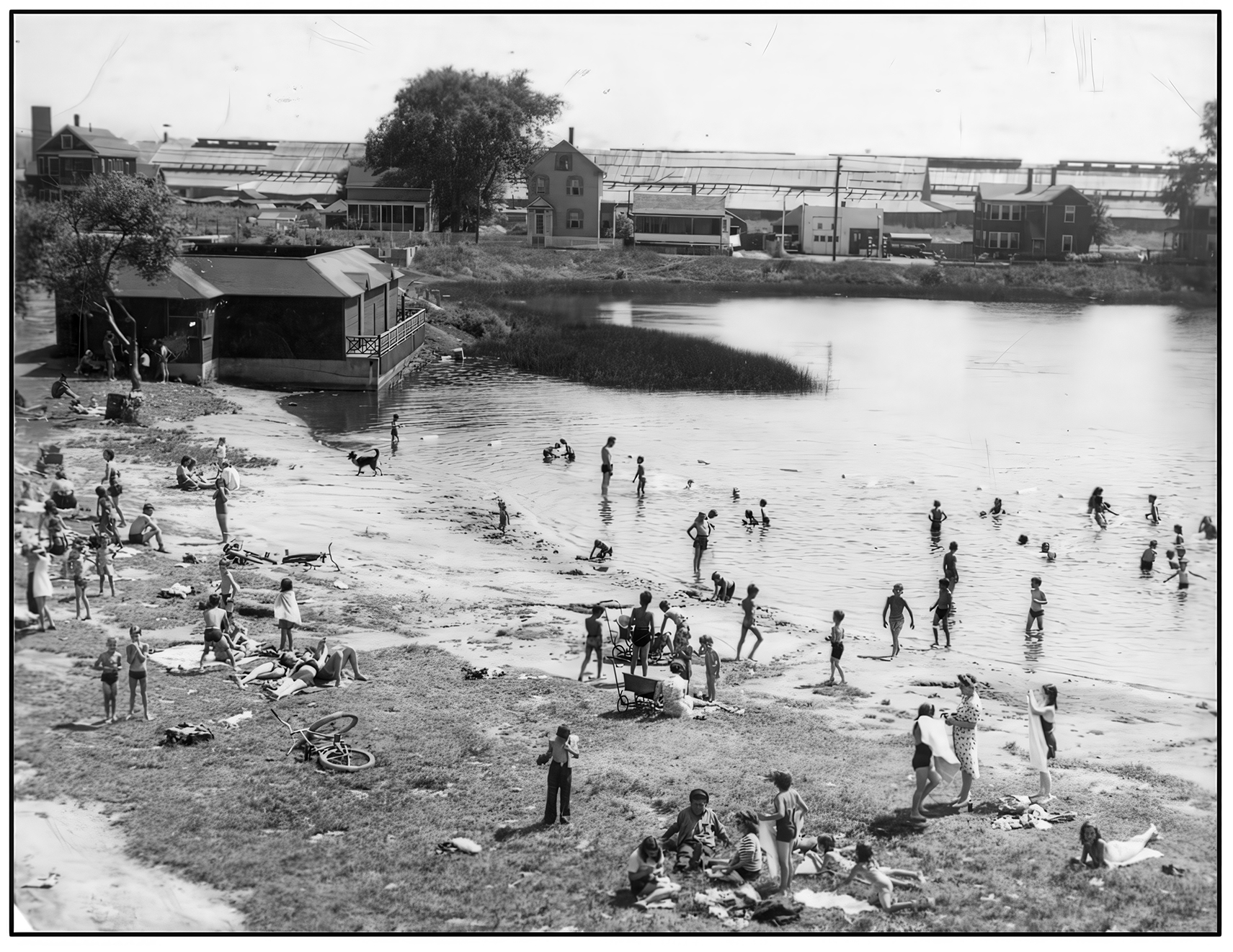
Jerry’s Pit is an artificial pond that was created about 1870 from a disused claypit. It is the last of many pits that cratered North Cambridge from the time rich clay-beds were discovered in 1844 until they were exhausted a century later.
Jerry’s Pit was probably named after Jeremiah McCrehan (1824-1907), a native of Ireland who first worked as a laborer in North Cambridge in the 1850s. McCrehan lived at 146 Rindge Avenue in the Kidder-Sergant-McCrehan house, which was built in 1792. When clay was discovered Solomon Sargent converted his farmhouse into a boarding house for brickyard workers and sold off his orchard for building lots, creating the Irish immigrant neighborhood of “Dublin.” McCrehan purchased the house in 1867, and it remained in his family until 1946.
In 1867, McCrehan and Charlestown brick-maker Garrett Neagle established a brickyard on Sherman Street and probably leased the claybed that became known as Jerry’s Pit. By 1870, the clay had been removed and the pit allowed to fill with water.
The McCrehan & Neagle partnership lasted until 1878, when its property was lost to foreclosure. In 1883, the DeRosay family, French Canadians who had learned the trade at the Bay State Brick Company, reopened the yard. Jeremiah McCrehan, however, had left the brick industry for good. He worked as a teamster until his death in 1907.
Soon after Jerry’s Pit filled with water an icehouse was built nearby to store blocks of ice that were cut there each winter. In the 1920s, when ice was no longer harvested from the pond, the insulated buildings were occupied by J. B. Johnson, an ice cream maker.
Jerry’s Pit was well known as a neighborhood swimming hole. Even though the property was privately owned, the Cambridge Park Department assumed supervision of the pond after the city built nearby Russell Field in 1913.
In the early 1940s, the Dewey & Almy Chemical Company, which piped water from the pond to its nearby plant, purchased the property and gave the City $5,000 to improve the beach and build a bathhouse.
From 1946 to 1951, fifteen barracks-like buildings next to the pond provided temporary housing for returning veterans. Swimming continued until the McCrehan Pool, named for Jeremiah’s grandson, Frank J. “Cheese” McCrehan, opened in 1961.
Sources
- Cambridge City Directories.
- Cambridge Historical Commission, Report Five: Northwest Cambridge. Cambridge, 1977.
- Cambridge Park Department Reports, 1913-1944.
- Cambridge City Engineer (photograph).
Links
- See all markers restored by this project
- North Cambridge historical markers (cambridgema.gov)